Philadelphia Rowhouse Laterals: Clay, Cast Iron, and Orangeburg
The year your Philadelphia rowhouse was built predicts what is buried in front of it. Clay joints admit roots, cast iron scales shut, and Orangeburg deforms, and each failure wants a different tool.
What era built what pipe in Philadelphia
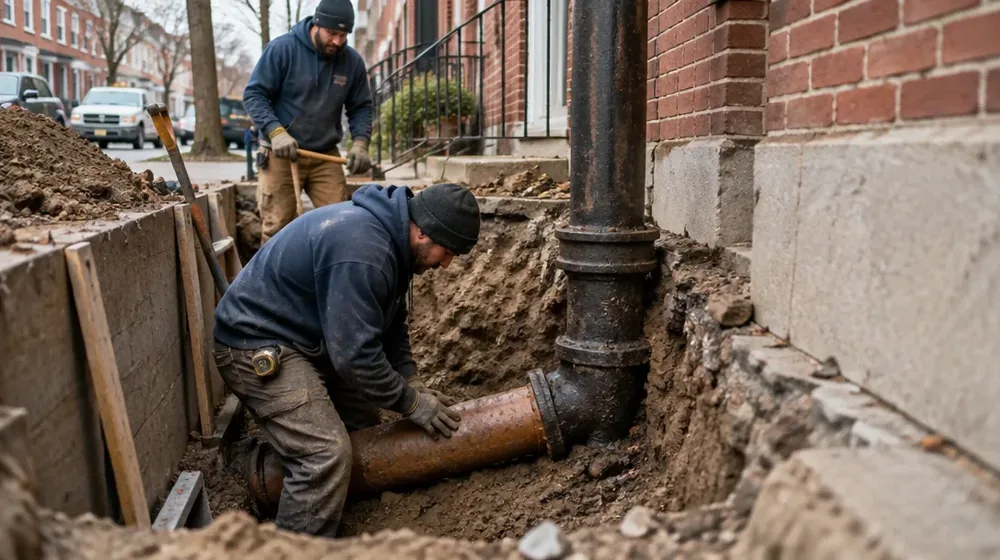
Philadelphia rowhouse construction falls into eras whose buried work is remarkably consistent. Homes built from the late nineteenth century through the 1930s, across South Philadelphia, Fishtown, Kensington, and much of West Philadelphia, typically left the foundation in vitrified clay segments with mortared joints to the city main, often transitioning to cast iron where the lateral penetrates the foundation wall. Post-war blocks in the Far Northeast and pockets of the Northwest laid heavier cast iron or early concrete with better jointing, while scattered mid-century replacements and additions introduced the full catalog of later materials including Orangeburg fiber pipe, thin-wall steel, and eventually PVC.
Those eras map directly onto failure modes visible on camera today. Clay fails at its joints, which shift with freeze-thaw heave, trench settlement, and delivery-truck loading over the sidewalk corridor, admitting roots and washing bedding fines until offsets and bellies develop. Cast iron fails from the inside out through tuberculation, where corrosion nodules grow into the bore, trap grease and paper, and eventually flake into scale that narrows the line to a fraction of its diameter. Orangeburg fails structurally, blistering and ovalizing under soil load until aggressive cleaning or even routine cabling deforms it further.
Later partial replacements complicate the picture on many blocks. A rowhouse that shows PVC at the basement cleanout may still run original clay beyond the property line, and a 1970s clay-to-iron transition under the areaway may hide the worst offset exactly where two materials meet. The only honest inventory is a camera run from the house to the main with footage marks, because era predicts probabilities while footage states facts at each joint and foot.
The Philadelphia Plumbing Code and the Pennsylvania Uniform Construction Code govern replacement materials, bedding, slope, and cleanout details for any correction, which is why permitted work with inspection matters beyond mere compliance. A lateral replaced to code with properly bedded jointless PVC and accessible cleanouts resets the material clock for decades, while an unpermitted patch with mismatched couplings restarts the failure sequence at the patch boundaries.
Clay: the jointed pipe that roots love
Vitrified clay itself is nearly indestructible; its joints are the entire problem. Each short segment ends in a bell or collar sealed originally with mortar or bituminous compound, and a century of soil movement, Schuylkill and Delaware valley frost heave, and vibration from street traffic opens those seals one by one. Once a joint leaks, it advertises moisture to every nearby root, admits hair that thickens into a dam, and begins exfiltrating flow that washes supporting fines from the bedding, which lets the joint offset further in a self-worsening loop.
On camera, clay reads as a rhythmic sequence of joints with the defects concentrated at the bells: root hair waving in the flow, paper snagged at an offset lip, standing water upstream of a settled segment. Sound clay with a single root entry is an excellent maintenance candidate, cut and flushed on a one-to-three-year cycle while the remaining joints hold. Clay with offsets at every joint, missing bedding, or visible soil through separations is a replacement candidate, because each maintained joint is one storm away from becoming a collapse.
Jetting sound clay is productive and safe at appropriate pressure, flushing the fines and sludge that cutting leaves behind and restoring the full bore the joints still allow. Jetting separated or collapsed clay is destructive, washing the remaining bedding out and converting a leak into a void that the sidewalk above eventually discovers. The pre-jet camera is therefore not optional on clay of unknown condition; it is the step that separates scouring from excavation.
Cast iron: the pipe that narrows from within
| Material | Typical Philadelphia era | Characteristic failure |
|---|---|---|
| Vitrified clay segments | Pre-war rowhouses, 1880s to 1930s | Joint offsets admit roots; bedding washes out |
| Cast iron | Foundation penetrations, post-war runs | Tuberculation scales the bore shut from inside |
| Orangeburg fiber pipe | Mid-century patches and replacements | Ovalizes and blisters; cleaning deforms it |
| Concrete and transite | Scattered mid-century mains and laterals | Crown erosion and joint leakage |
| PVC and HDPE | Modern replacements to code | Jointless and root-proof; fails only at bad joints or crush |
Cast iron fails invisibly for years before it fails suddenly. Internal corrosion builds rough tubercles that catch grease and paper, the bore narrows until the line behaves like a smaller pipe, and the wall beneath the nodules thins until flakes of scale break free and jam downstream. Philadelphia basement exposures accelerate the process where uninsulated runs sweat through freeze cycles and where laundry and kitchen discharge alternate hot and cold, stressing already thin walls.
Descaling iron with chain flails or rotary jetting restores dramatic diameter on camera and is among the most satisfying services in drain work, but it cannot restore wall thickness already consumed. The post-descale camera must judge remaining wall honestly: uniform iron with good thickness earns years of extended life, while paper-thin sections with pinholes or visible soil behind flakes want replacement before the next pressure event, whether that event is a jetter or merely a holiday laundry surge. Homeowners should expect that judgment in writing with footage references rather than as a verbal reassurance.
Orangeburg and the materials that forbid pressure
Orangeburg, the tar-impregnated wood-fiber pipe sold as a lightweight post-war alternative, appears in scattered Philadelphia replacements where a quick mid-century fix was needed. It was never a durable sewer material: it absorbs moisture, blisters inward, ovalizes under soil and sidewalk loading, and deforms under the very tools that clear other pipe. Cabling can spear through its softened wall and jetting can collapse a weakened oval into a full blockage, which is why identification before any mechanical work is a professional obligation rather than a preference.
On camera, Orangeburg reads as a dark, fibrous oval with longitudinal blisters and bellies that hold water along extended sags rather than at discrete joints. Where it is found, the honest recommendation is replacement planning rather than cleaning optimization, with gentle maintenance only as a bridge to the capital project. Any figure for work on an Orangeburg run should state the deformation risk explicitly and price the replacement path alongside, so the homeowner never pays cleaning money for a pipe that needs retirement.
Thin-wall steel, deteriorated transite, and collapsed concrete segments belong in the same do-not-pressurize category when the camera shows them failing. The principle generalizes beyond any single brand name: pressure is for sound pipe, and the camera decides soundness. Philadelphia blocks with mixed-material patch histories are where this discipline pays most, because the worst segment hides at the coupling between eras.
How the camera identifies each material and defect
Launch from a proper cleanout
Stable footage references from a known point; pulled-fixture launches wander and mislead.
Log material transitions
Where clay becomes iron becomes PVC, with the couplings and offsets at each change.
Mark every defect with footage and depth
Entry joints, scale extent, bellies with standing water, and surface locate at the curb.
Judge wall, not just bore
Remaining iron thickness, clay joint integrity, Orangeburg ovality, bedding condition.
Record and keep the file
Video with marks that any future bidder can price from without re-exploring.
Decide tool from footage
Cut, scour, descale, maintain, or replace as the material and defects dictate.
A competent Philadelphia camera visit takes longer than the clearing visit it precedes and saves more than it costs. The operator narrates material, diameter changes, and defects in real time, surfaces-locates key points so depths are known before any digging figure is discussed, and hands over a file rather than a verbal summary. Homeowners should treat a contractor unwilling to share the file the way they would treat a mechanic unwilling to show the failed part.
Sewer camera inspection as a standalone service earns its fee most on three occasions: before buying any pre-1970 rowhouse, when any line has backed up twice in two years, and before authorizing any lining or replacement figure. Each occasion converts an invisible lateral into a documented asset with footage, depths, and material boundaries, which is the foundation every later decision stands on.
Repair paths matched to what the footage shows
Sound pipe with a single defect wants a spot solution. One root-entry joint in otherwise good clay, one scaled section of iron with solid wall elsewhere, or one offset coupling at a material transition can each be addressed locally without disturbing the sound remainder. Spot repairs in the sidewalk corridor require coordination with city right-of-way expectations and restoration of the surface, which is why the footage depth at the curb and the permit path under the Philadelphia Plumbing Code belong in the figure before authorization rather than appearing as extras.
Uniformly failing runs want end-to-end correction. Clay with open joints along its length, iron scaled thin throughout, or any run containing Orangeburg rewards jointless replacement or full-length lining rather than a sequence of spots that chase failure down the trench. Replacement with bedded PVC and proper slope plus accessible two-way cleanouts resets the lateral for the service life of the house, while lining preserves the trench and surface where excavation would be disproportionate. Either path should be priced with footage, depth, restoration, and inspection stated.
Bellies deserve special mention because neither spots nor lining corrects a sag. A bellied segment holds water by grade rather than by roughness, so only regrading or replacing that segment restores self-scouring flow. Lining a belly preserves the low spot inside a new pipe, and jetting a belly on schedule merely rents capacity between sedimentations. Footage showing water sitting mid-line with debris drifting back after flushing is the finding that redirects money from cleaning to correction.
Living with old laterals on old blocks
Most Philadelphia rowhouse laterals will never be new all at once, and that is fine. A managed old lateral with known material boundaries, logged defect footage, a maintenance interval set from history, and a repair figure held in reserve serves reliably for years while the household budgets the capital project on its own schedule. What fails is the unmanaged lateral: unknown material, no footage, emergency-only attention, and decisions made under sewage rather than under information.
Freeze cycles and combined-sewer surcharge set the management calendar. Verify insulation on basement iron exposures before deep winter so condensation and frost do not accelerate corrosion, confirm exterior cleanout caps seat properly against frost entry, and prove full-bore capacity before the summer convective season that surcharges Philadelphia combined mains and punishes every narrowed lateral. The Schuylkill and Delaware corridors funnel the heaviest cells directly over the oldest blocks, so capacity planning should assume the storm slug rather than the dry trickle.
At purchase, at recurrence, and before any capital figure, scope the line. Era predicts the material, the camera proves it, and every paragraph of this guide reduces to that order. Homeowners who hold footage with depths negotiate every service and every repair from knowledge, which on Philadelphia rowhouse blocks is the only durable advantage available.
Frequently asked questions
What pipe is my Philadelphia rowhouse lateral made of?
Era predicts: pre-war rowhouses typically clay with iron at the foundation, post-war blocks heavier iron or concrete, scattered mid-century patches sometimes Orangeburg, modern replacements PVC. Only a camera run to the main with footage marks states the facts for your address, including transitions between materials.
Can you jet clay or cast iron safely?
Sound clay and sound iron jet productively at matched pressure, restoring bore the camera then verifies. Separated clay, paper-thin scaled iron, and Orangeburg must not be pressurized, which is why the pre-jet camera decides rather than the schedule.
What is Orangeburg and why does it matter?
A tar-impregnated fiber pipe used for some mid-century fixes that ovalizes, blisters, and deforms under cleaning tools. Where the camera finds it, plan replacement rather than optimizing cleaning, with gentle maintenance only as a bridge.
Spot repair, lining, or full replacement?
One defect in sound pipe favors a spot; uniform joint failure or thin iron throughout favors end-to-end lining or replacement; bellies need regrading regardless. Footage with depths plus a permitted figure for each path makes the comparison honest.
Should I scope a lateral before buying a rowhouse?
Yes for anything pre-1970 or with any backup history. A pre-purchase camera with kept footage and depths costs a fraction of a lateral correction and converts the most expensive invisible system in the house into a documented asset before negotiation closes.
Services mentioned in this guide
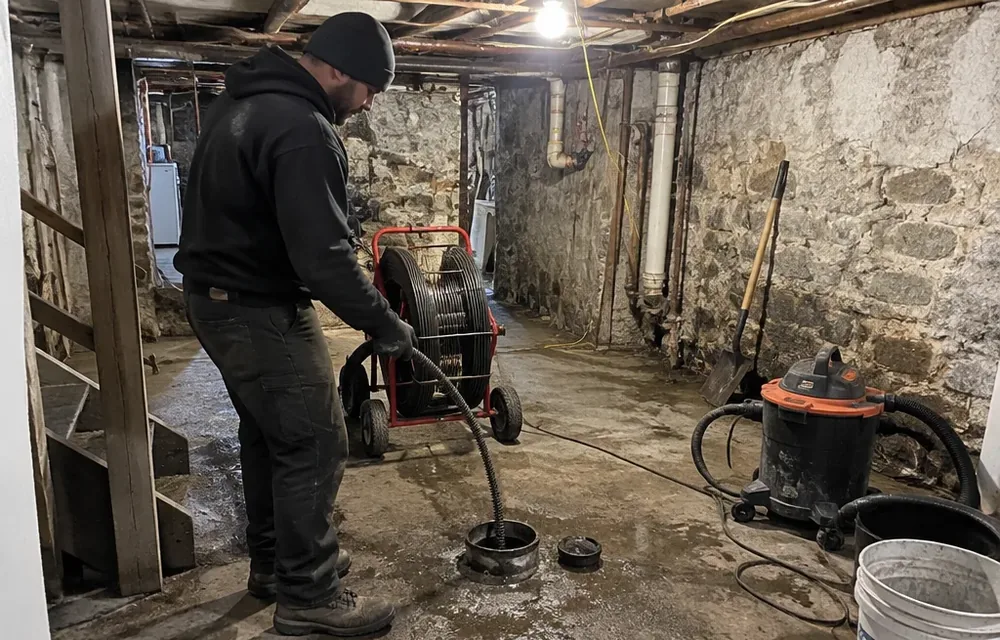
Main Sewer Line Cleaning
The lateral is the most expensive drain you own — a 60-to-100-foot clay run from your rowhouse to the street main, shared with stormwater, hunted by street-tree roots.
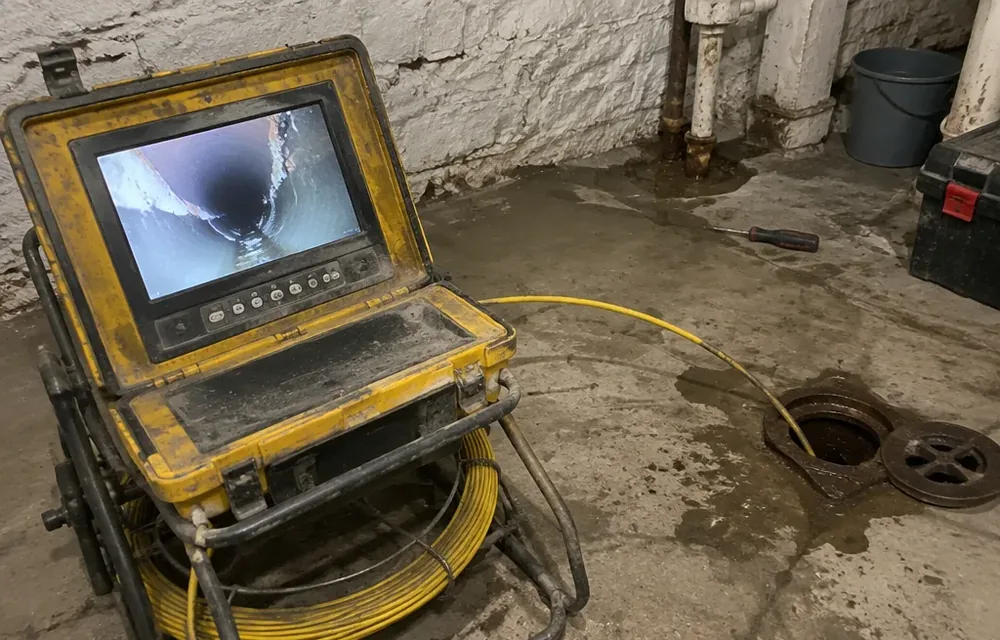
Sewer Camera Inspection
Every expensive sewer decision in Philadelphia — jet, repair, line, replace — depends on one thing: what the pipe actually looks like inside.
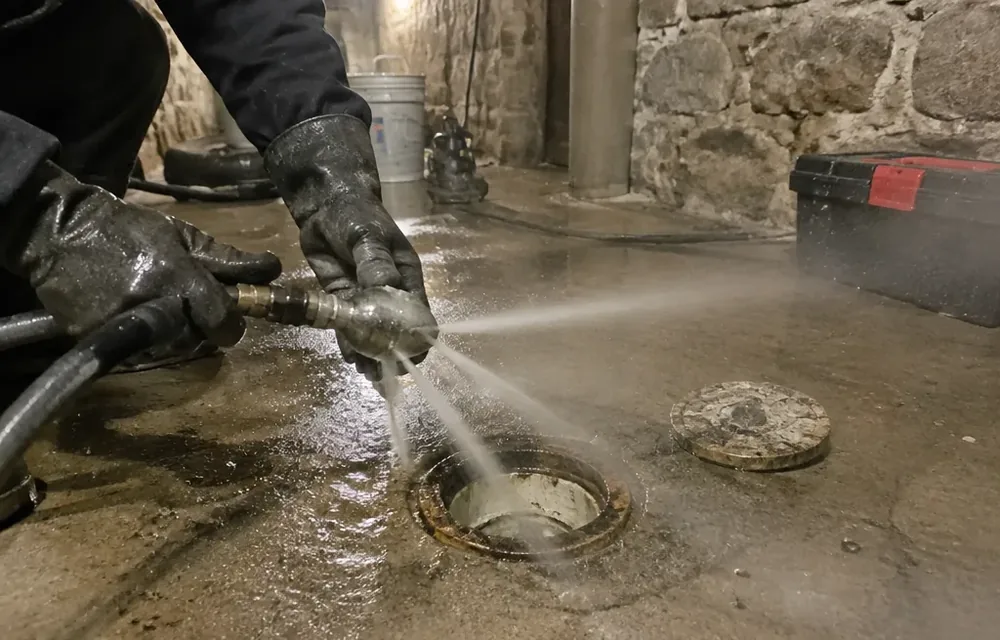
Hydro Jetting
A cable bores a hole through the clog.
Free tools that help with this exact problem
More guides
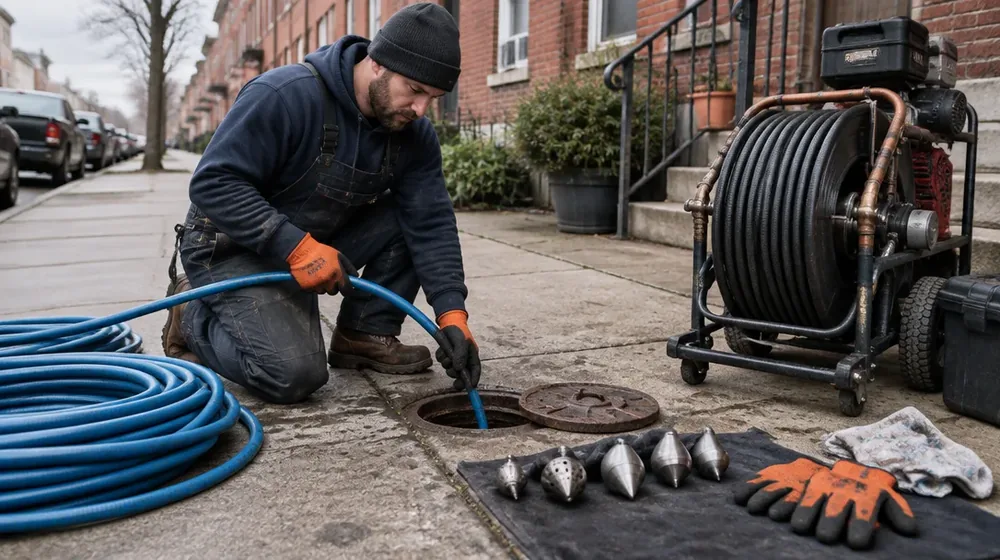
Hydro Jetting vs Snaking: What Philly Homes Need
A cable bores a hole through the blockage so water moves again. A jetter scours the whole pipe wall back toward bare m…

Hydro Jetting Cost in Philadelphia: 2026 Guide
Most Philadelphia homeowners budget around national jetting ranges, then discover access, lateral length, and root cut…
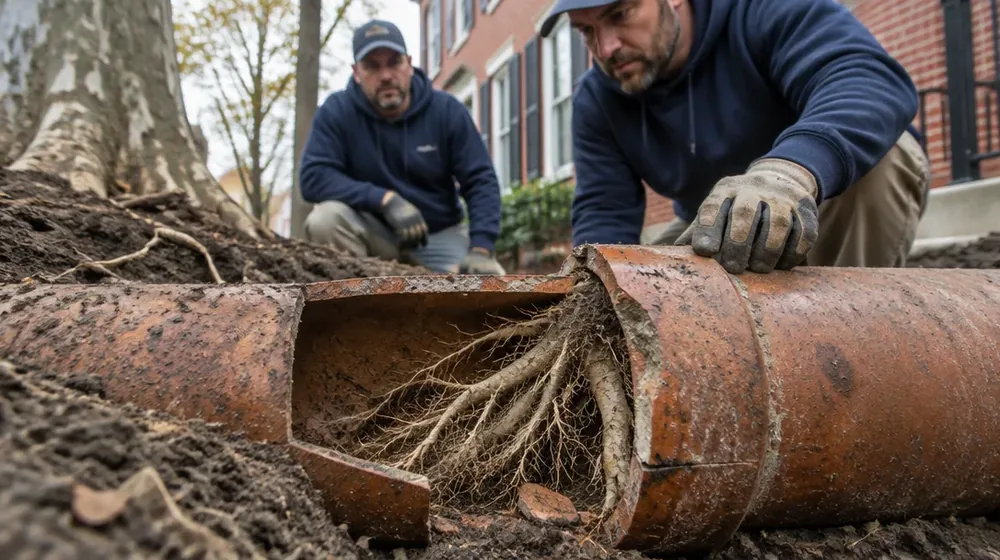
Tree Roots in Philadelphia Sewer Lines Guide
Roots do not break into sound pipe. They find the clay joint that is already leaking, thicken in the flow, and become …
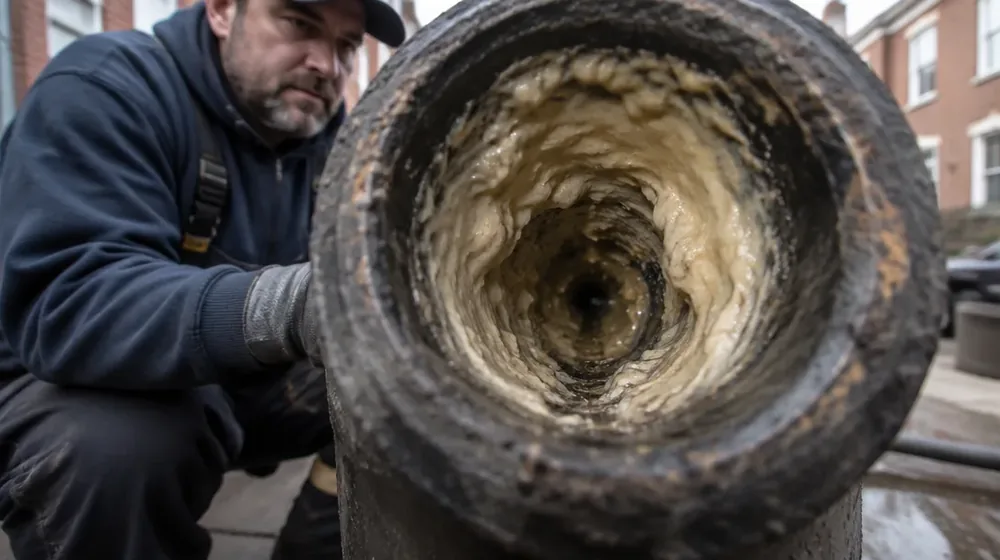
Grease Lines: Philly Rowhouses & Restaurants
Grease goes down warm and liquid, meets cold iron, and becomes a wall coating rather than a plug. That is why the same…