Drain cleaning and sewer service in Jenkintown, Pennsylvania
Jenkintown is a compact turn-of-the-century borough on the Old York Road corridor — York Road, West Avenue, Greenwood Avenue, and the SEPTA junction — where 1900–1930 twins, porch-front rows, and brick singles sit on clay tile laterals now approaching a century of service. Mature borough maples and oaks stand over nearly every run, and the borough’s small lots mean shallow but root-packed laterals where three or four intrusions on one camera pass is routine. Fringe blocks toward Abington and Cheltenham built in the late 1940s carry Orangeburg laterals that behave nothing like the borough-core clay, so build-year identification decides the scope before any digging starts.
- Montgomery County
- Montgomery County
- Answered 24/7
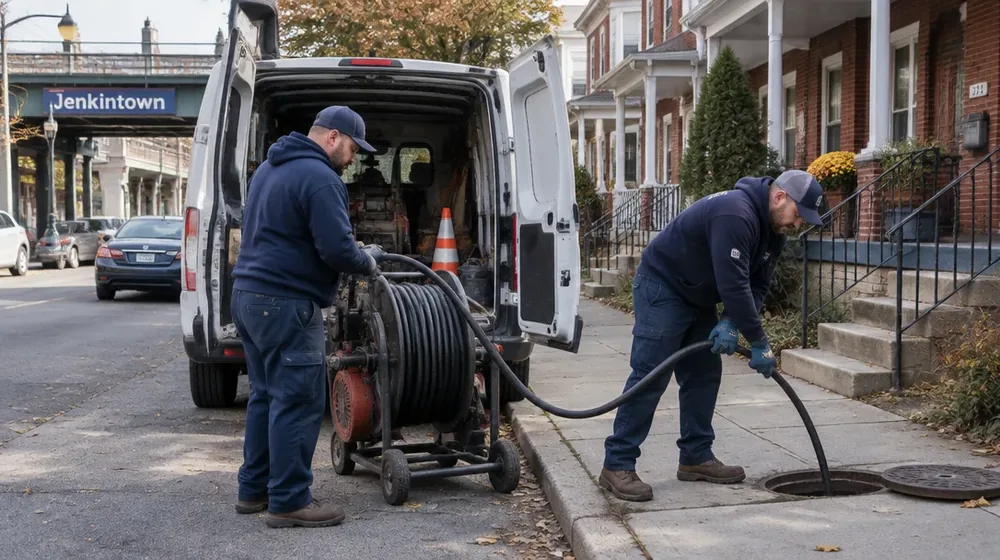
Jenkintown at a glance
County: Montgomery County · Area: Montgomery County · Neighborhoods covered: 8
What goes wrong with Jenkintown plumbing
Borough-core clay packed with roots
Jenkintown’s maples and oaks have colonized century-old clay hubs from York Road to Greenwood Avenue. Single spot repairs fail in rotation as the next joint over keeps growing, so full-run camera mapping followed by lining that seals every joint is the standard durable answer where the trees remain.
Orangeburg fringe blocks
Streets toward the Abington line built from roughly 1945 to 1960 can carry fiber pipe that blisters and ovals in wet ground and generally cannot be lined. Finding Orangeburg on camera reframes the job from repair to replacement, which belongs in a purchase negotiation rather than discovered after closing.
Tight-lot access economics
Small Jenkintown lots with shared walls, narrow side yards, and mature plantings make open excavation disproportionately disruptive. Trenchless lining from small pits frequently costs less all-in than trench once restoration of walks, walls, and plantings is counted.
Housing stock and pipe materials
Housing: Predominantly 1900–1930 twins, rows, and brick singles in the borough grid, with Victorian survivors near York Road and postwar infill toward the Abington and Cheltenham lines.
Likely pipe materials: Vitrified clay tile on most pre-1945 borough laterals, Orangeburg on late-1940s fringe blocks, cast iron interior drains in most homes built before 1975, PVC/ABS on replacements and newer infill.
Who owns the sewer pipe under the street in Jenkintown? Usually the homeowner, all the way to the public main. Jenkintown's public works office can confirm where your part ends; the guide to laterals explains the rest.
Neighborhoods in and around Jenkintown
York Road corridor, West Avenue, Greenwood Avenue, SEPTA junction district, Leedom Street, Cottman edge, Abington border blocks, Cheltenham border blocks.
Towns near Jenkintown
Drain services in Jenkintown
Guides and symptom checks matched to Jenkintown's housing
Guides for homes like these
- Tree Roots in Philadelphia Sewer Lines Guide — why clay joints open and what the camera should log
- Philly Rowhouse Laterals: Clay, Iron & More — which pipe your build era used and what each needs
- Camera Inspection Before Hydro Jetting Guide — when scoping must come before any pressure
Symptoms common in Jenkintown
- Same Clog Keeps Returning — repeat clogs mean coating or defect, not bad luck
- All Drains Slow — whole-house slowness means main line, not fixture
- Drain Gurgling — what gurgling says about vents and mains
Jenkintown plumbing questions
Spot repair or lining for a Jenkintown borough lateral?
Lining once mapped. Century-old clay from York Road to Greenwood Avenue shows three or four intrusions per run under borough maples and oaks, and isolated repairs fail in rotation. A liner seals every joint at once from small pits, which also fits Jenkintown’s tight lots with shared walls and narrow side yards.
Which Jenkintown blocks carry Orangeburg?
Fringe streets toward Abington built roughly 1945 to 1960. Borough-core clay behaves nothing like fringe fiber pipe, so build-year identification before scoping decides whether the answer is lining (sound clay) or replacement (failed Orangeburg).
Why does excavation cost so much on a small Jenkintown lot?
Because small lots concentrate restoration. Shared walls, narrow side yards, walks, and mature plantings make open trench disproportionately disruptive, and restoration of that surface frequently exceeds the lining price that leaves it intact.
Should Jenkintown buyers camera the lateral?
On any pre-war twin or row, yes. Multi-joint intrusion with 100-year-old clay and cast iron at end of life is a five-figure scope item, and fringe Orangeburg reframes it as replacement. A mapped inspection belongs in the negotiation before closing.