Drain cleaning and sewer service in Swarthmore, Pennsylvania
Swarthmore is Delaware County’s college borough — grown around Swarthmore College’s 1864 campus, the Crum Creek woods, and the Yale Avenue, Park Avenue, and Rutgers Avenue grids — where early-1900s stone and stucco colonials, twins, and faculty houses dominate the drain map. Laterals are vitrified clay tile with cast iron inside, now roughly a century old, running beneath some of the heaviest mature beech, oak, and tulip-poplar cover in Delaware County. The borough falls toward the Crum Creek watershed on both sides, so hillside groundwater moves through open clay hubs from autumn through spring, and Crum Creek tributary swales hold the water table high along the valley streets from the Springfield line to the Wallingford edge.
- Delaware County
- Delaware County
- Answered 24/7
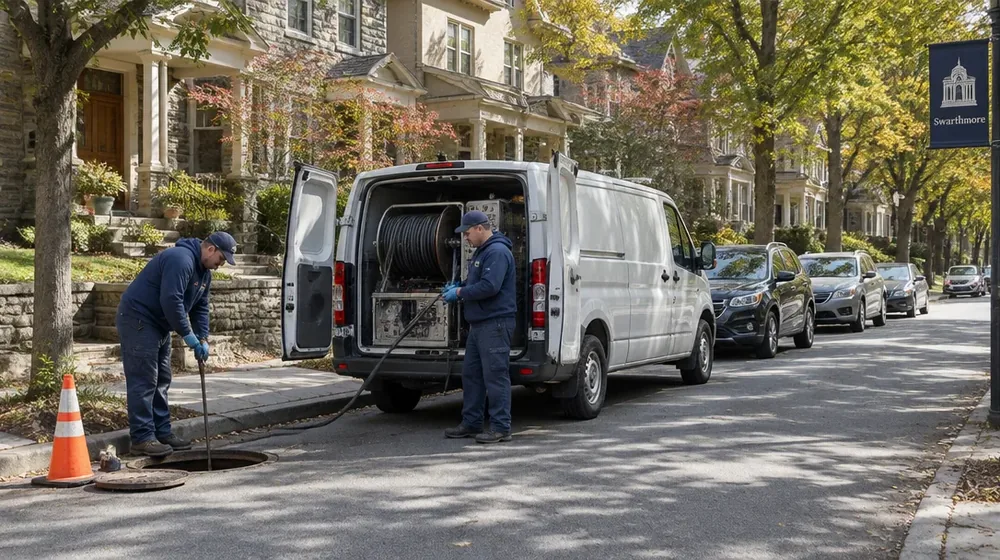
Swarthmore at a glance
County: Delaware County · Area: Delaware County · Neighborhoods covered: 9
What goes wrong with Swarthmore plumbing
College-borough beech and oak roots
Swarthmore’s signature beech, oak, and tulip-poplar canopy stands directly over century-old clay hubs from Yale Avenue to Rutgers Avenue, and beech roots in particular travel far to find joint moisture. Camera runs routinely show intrusion at four or more hubs, which rules out spot-repair economics and points to full-run lining that seals every joint while the canopy stands.
Crum Creek watershed infiltration
Ground draining toward Crum Creek on both sides of the borough carries winter groundwater that enters every open clay joint for months. Valley-street laterals run partially full of infiltration all season, so January backups with no new clog are capacity failures. Sealing the joints by lining restores the headroom that repeated clearing never does.
Stone-foundation seep cross-flow
Swarthmore stone colonials with rubble foundations admit winter seep that migrates toward floor drains tied to the sanitary lateral, overloading clay lines already carrying watershed infiltration. Separating clean foundation water from the sanitary run plus sealing the clay joints is the durable pair for the Park Avenue and college-hill blocks.
Housing stock and pipe materials
Housing: Predominantly early-1900s stone and stucco colonials, twins, and faculty houses around the college and the Park Avenue grid, with 1920s–1940s infill toward the Springfield and Morton lines.
Likely pipe materials: Vitrified clay tile on most pre-1940 Swarthmore laterals, cast iron interior and stack lines in nearly all the early-1900s stock, PVC/ABS only on replacements and limited newer infill.
Who owns the sewer pipe under the street in Swarthmore? Usually the homeowner, all the way to the public main. Swarthmore's public works office can confirm where your part ends; the guide to laterals explains the rest.
Neighborhoods in and around Swarthmore
Swarthmore College vicinity, Yale Avenue, Park Avenue grid, Rutgers Avenue, Crum Creek valley streets, Springfield line, Morton edge, Wallingford edge, Chester Road corridor.
Towns near Swarthmore
Drain services in Swarthmore
Guides and symptom checks matched to Swarthmore's housing
Guides for homes like these
- Tree Roots in Philadelphia Sewer Lines Guide — why clay joints open and what the camera should log
- Philly Rowhouse Laterals: Clay, Iron & More — which pipe your build era used and what each needs
- Camera Inspection Before Hydro Jetting Guide — when scoping must come before any pressure
Symptoms common in Swarthmore
- Water Backing Up Into Fixtures — when one fixture fills another, act fast
- Same Clog Keeps Returning — repeat clogs mean coating or defect, not bad luck
- Water in the Basement Floor Drain — water at the floor drain during rain
Swarthmore plumbing questions
Why do Swarthmore beech trees cause so much sewer trouble?
Beech roots travel far to find joint moisture, and Swarthmore’s beech, oak, and tulip-poplar canopy stands directly over century-old clay hubs from Yale Avenue to Rutgers Avenue. Four or more intrusions on one camera run is routine, which rules out spot-repair economics and points to full-run lining that seals every joint while the trees stand.
My Swarthmore colonial backs up every winter. Why?
Ground draining toward the Crum Creek watershed enters open clay joints all winter, and valley-street laterals run partially full of infiltration for months. January backups with no new clog are capacity failures — sealing sound clay by lining restores the headroom that repeated clearing never does.
What pipe does a 1910 Swarthmore stone house have?
Vitrified clay tile outside with cast iron stacks inside, roughly a century old. Expect roots at the hubs outside and invert scale inside the iron together on one camera run, plus winter seep where rubble stone foundations route water toward floor drains tied to the lateral.
Do I need borough approval for Swarthmore lateral work?
Any excavation in the public right-of-way needs borough approval and inspection, and the responsibility split at the curb should be confirmed with the borough before work starts. Permitted work with inspections protects the resale file on Swarthmore’s high-value stone stock.