Drain cleaning and sewer service in Upper Darby, Pennsylvania
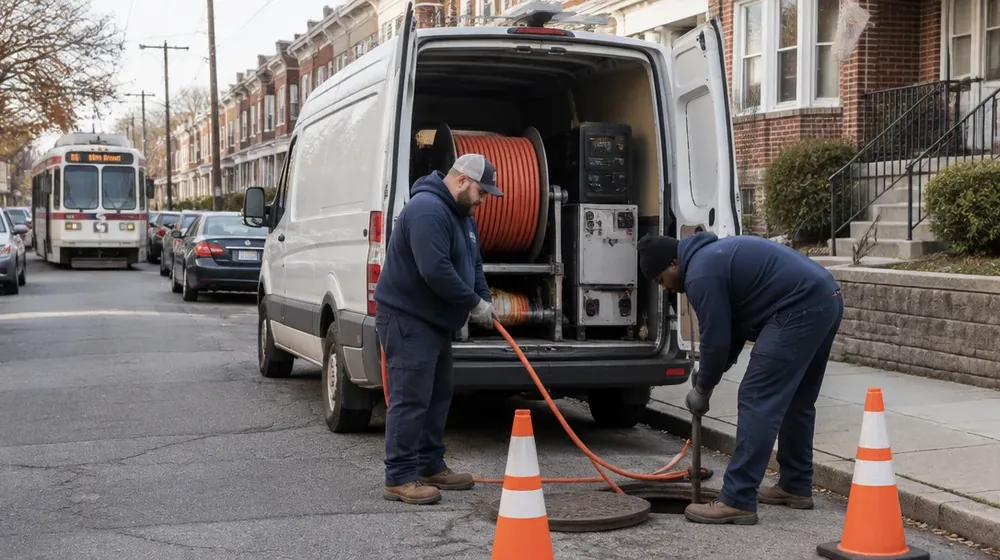
Upper Darby is the most densely built town in Delaware County: block after block of 1920s–1940s brick rowhouses and twins packed tight around 69th Street, Terminal Square, Drexel Hill, and the Market-Frankford Line corridor. That density defines the plumbing. Laterals are short but shared-wall rowhouses mean limited access, clay tile with mortared joints under nearly every pre-war street, cast iron stacks inside, and mature street maples and oaks whose roots have had eighty years to find each joint. Delaware County clay soils around Cobbs Creek and the Darby Creek watershed drain slowly, so winter groundwater sits against foundations and enters laterals through the same cracks roots use. Calls here cluster as whole-block patterns: when one 1930s row lateral fails, the neighboring houses built the same year by the same builder are on the same clock.
- Delaware County
- Delaware County
- Answered 24/7
Upper Darby at a glance
County: Delaware County · Area: Delaware County · Neighborhoods covered: 10
What goes wrong with Upper Darby plumbing
Dense rowhouse clay with roots at every joint
Upper Darby rowhouses went up fast in the 1920s and 1930s with clay tile laterals in short mortared segments, and the street trees above them are now fully mature. Roots enter at one joint and travel the line, so single spot repairs fail while the next joint over keeps growing. Full-run camera inspection matters more here than anywhere else in Delaware County because access between shared walls is tight and a second excavation costs dearly.
Cast iron stacks at end of service life
The 1925–1945 brick rows that define Drexel Hill, Stonehurst, and Highland Park carry cast iron soil lines now 80-plus years old. The invert corrodes thin, scale catches paper and grease, and cabling gives briefer relief each visit. Whole-house slow drainage that returns within weeks is the signature, and lining or replacement planning beats repeated clearing.
Clay-soil groundwater feeding infiltration
Delaware County clay around Upper Darby sheds water poorly, and homes near Cobbs Creek and the Naylors Run valley carry a seasonally high water table. Groundwater enters cracked clay joints all winter, so the lateral runs half full of infiltration before household flow is added. Winter backups here are frequently an infiltration-capacity problem rather than a discrete clog.
Housing stock and pipe materials
Housing: Heavily 1920s–1940s brick rowhouses and twins in Drexel Hill, Highland Park, Stonehurst, and around 69th Street, with garden apartments along Market Street and West Chester Pike and postwar duplexes toward Llanerch and Manoa.
Likely pipe materials: Vitrified clay tile on nearly all pre-1950 laterals, cast iron interior drains and stacks in the rowhouse majority, with small pockets of Orangeburg on late-1940s to early-1950s construction and PVC/ABS only on replacements and newer infill.
Who owns the sewer pipe under the street in Upper Darby? Usually the homeowner, all the way to the public main. Upper Darby's public works office can confirm where your part ends; the guide to laterals explains the rest.
A closer look at Upper Darby
Why one builder’s street fails all at once
Upper Darby’s 1920s–1940s brick rows around 69th Street, Terminal Square, Drexel Hill, Highland Park, and Stonehurst went up street by street with identical clay tile laterals and cast iron stacks. Pipe from one builder in one year ages identically, so laterals on a single block reach end of life together rather than one house at a time.
The practical consequence is neighbor-matched scope: when one attached row lines a lateral riddled at every hub, the adjoining houses carry the same clay of the same age under the same maples. Scoping the block together replaces three emergency excavations between shared walls with one planned trenchless run.
Delaware County clay and the Cobbs Creek water table
Upper Darby sits on Delaware County clay that sheds water poorly, with the Cobbs Creek and Naylors Run valleys holding winter groundwater high. From November through March that water enters every open clay joint, so laterals run partially full of infiltration for months before any fixture is used.
This is why Upper Darby backups cluster with sustained winter wet rather than with usage, and why clearing a line in January often gives only brief relief while the water table stays up. The durable fix seals the joints — lining sound clay — which stops infiltration and root entry in the same operation.
Shared-wall access makes trenchless the default
Rowhouse laterals between shared walls leave almost no room for open excavation without disturbing adjoining properties, front steps, walks, and mature street plantings. A second dig on the same row costs far more in restoration and neighbor coordination than the first.
Full-run camera mapping with depths comes before any commitment, and lining from two small pits then seals every joint at once. On Upper Darby rows the restoration arithmetic — not just the pipe price — is what makes trenchless the standard recommendation.
Neighborhoods in and around Upper Darby
69th Street and Terminal Square, Drexel Hill (Garrett Road), Highland Park, Stonehurst, Llanerch, Manoa and Township Line, Bywood, Primos-Secane edge, Westbrook Park, Aronimink.
Towns near Upper Darby
Drain services in Upper Darby
Guides and symptom checks matched to Upper Darby's housing
Guides for homes like these
- Tree Roots in Philadelphia Sewer Lines Guide — why clay joints open and what the camera should log
- Grease Lines: Philly Rowhouses & Restaurants — why grease constrictions need scouring, not cabling
- Philly Rowhouse Laterals: Clay, Iron & More — which pipe your build era used and what each needs
Symptoms common in Upper Darby
- All Drains Slow — whole-house slowness means main line, not fixture
- Water Backing Up Into Fixtures — when one fixture fills another, act fast
- Same Clog Keeps Returning — repeat clogs mean coating or defect, not bad luck
Upper Darby plumbing questions
Why do whole Upper Darby blocks have drain trouble in the same year?
Because whole blocks were built in the same year by the same builder. The 1920s–1940s brick rows around 69th Street, Drexel Hill, and Stonehurst share identical clay tile laterals and cast iron stacks, so they reach end of life together. When your attached neighbor lines a lateral, scoping yours is prudent planning rather than pessimism.
My Upper Darby rowhouse drains slowly everywhere. Is it a clog?
Usually it is pipe condition, not a discrete clog. Cast iron stacks in 1925–1945 Upper Darby rows corrode along the invert into a rough scaled bore that catches everything, and clay joints admit roots at hub after hub. Cabling gives briefer relief each visit because each pass removes a little more of what is left. A camera grade of wall condition settles whether the line is maintainable or due for lining.
Do I need a permit for lateral work in Upper Darby?
Any work in the public right-of-way needs township approval and inspection, and the responsibility split at the curb line should be confirmed with Upper Darby Township before work starts. Unpermitted sewer work resurfaces at resale in Delaware County, and resolving it retroactively costs far more than permitting it correctly the first time.
Why does my Upper Darby basement back up every January?
Delaware County clay around Cobbs Creek and the Naylors Run valley holds winter groundwater high, and it enters cracked clay joints for months. Your lateral then runs partially full of infiltration before any fixture is used, leaving no headroom for household flow. The January backup on a line that behaved all summer is the classic infiltration signature, and sealing the joints is what restores capacity.
Trench or trenchless for an Upper Darby rowhouse?
Trenchless usually wins because access between shared walls is tight and excavation must cross walks, steps, and mature plantings. Lining seals a full clay run from two small pits, while open trench along a shared-wall row disturbs far more and restores far more. Camera mapping with depths decides it, but the restoration arithmetic favors lining on most Upper Darby rows.